Description
1. Product Structure and Working Principle
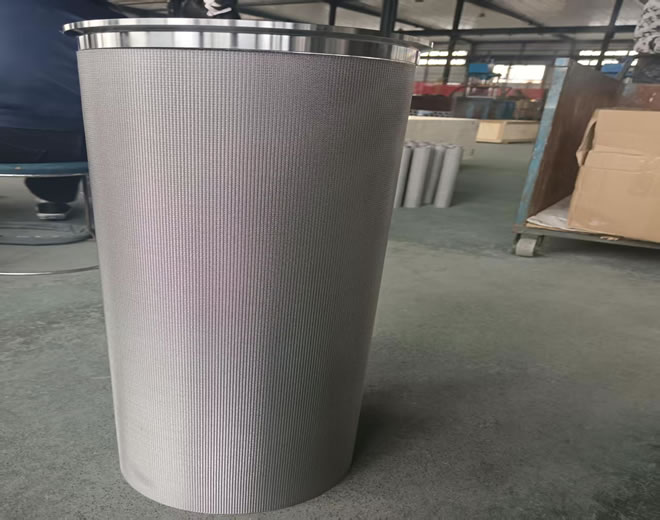
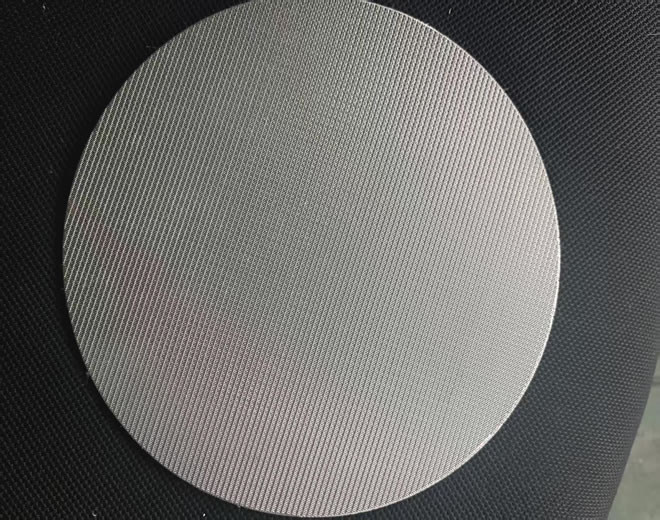
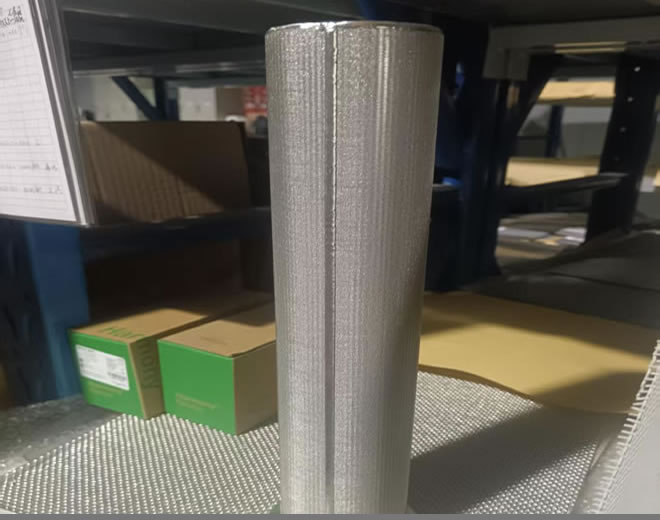
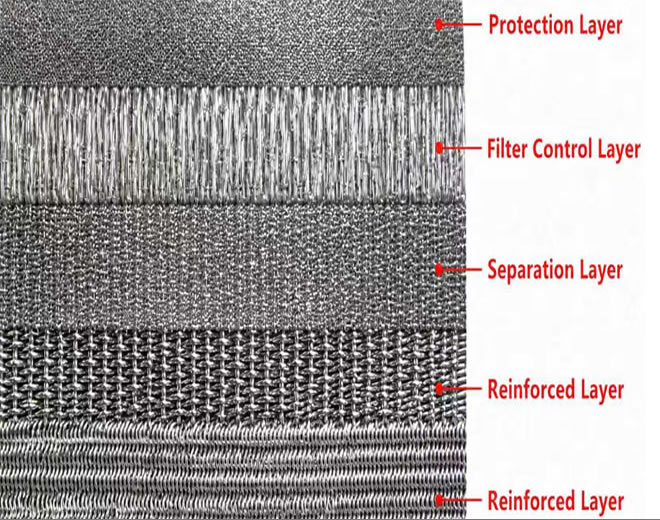
Standard five-layer sintered mesh consists of a protective layer, a filtration layer, a dispersion layer, and two support layers. The individual metal mesh layers are precisely stacked and bonded by high-temperature vacuum sintering to form a stable, integrated porous structure.
Each layer has a defined role. The protective layer shields the outer surface. The filtration layer determines the filtration rating. The dispersion layer distributes fluid more evenly across the working area. The two support layers provide the mechanical strength and pressure resistance the element requires.
Unlike conventional depth filtration media, five-layer sintered mesh works primarily through surface filtration. Its regular flow channels and relatively smooth surface retain particles mainly on the filtration face, which gives the material strong backwashing performance and allows it to be cleaned repeatedly over a long service life.
2. Key Product Advantages
High structural strength — the multilayer sintered construction offers excellent rigidity and compressive strength.
Stable filtration performance — the uniform pore distribution helps maintain consistent filtration accuracy.
Easy cleaning and regeneration — supports backwashing, ultrasonic cleaning, and other suitable cleaning methods.
Good fabrication performance — easy to form, weld, and assemble, and can be made into a wide range of filter elements.
3. Materials and Technical Specifications
Standard grades are SUS304 and SUS316L stainless steel. Duplex stainless steel and Hastelloy alloys are available for more corrosive operating environments.
The filtration rating covers 2 to 200 μm, with a reference operating temperature range of −200 °C to 650 °C. A variety of standard sizes are available, and customised dimensions can be produced to customer requirements.
4. Application Fields
sintered mesh is widely used in chemical processing, petrochemical, pharmaceutical, food, and general indusWith its stable filtration performance, mechanical strength, and repeated cleanability, five-layer trial fluid filtration applications.
Through the rational design of its multilayer structure, five-layer sintered mesh achieves a practical balance between filtration precision, pressure resistance, and regeneration performance — a metal filtration material well worth considering for industrial precision filtration systems.