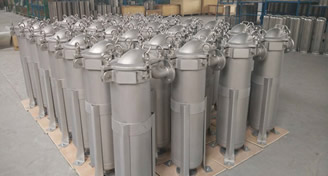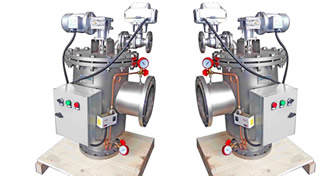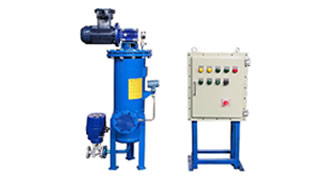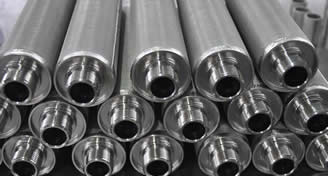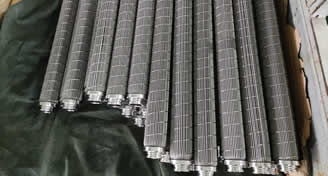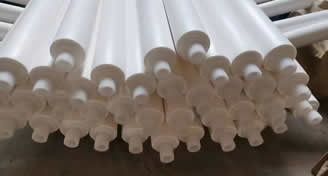
In the realm of industrial filtration, filter elements made of stainless steel dominate the high-end market due to their corrosion resistance, high-temperature tolerance, and cleanable/reusable nature. However, a "battle of precision" constantly rages between two mainstays of the stainless steel family: the Sintered Mesh Filter Element and the Stainless Steel Pleated Filter Element.
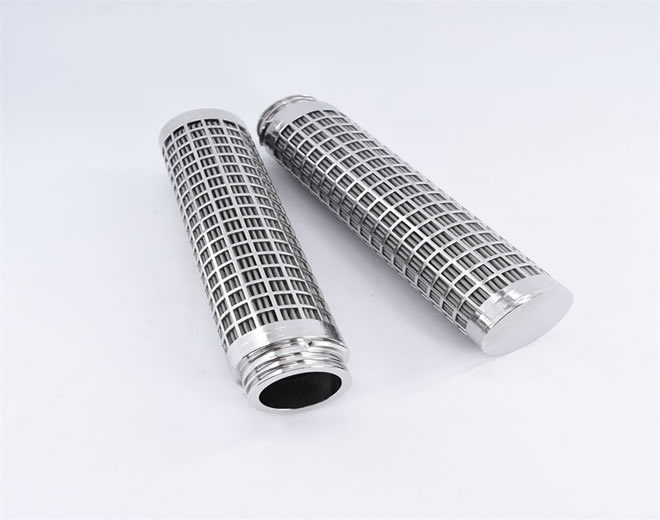
To compare precision, one must first understand the differences in their "skeletons."
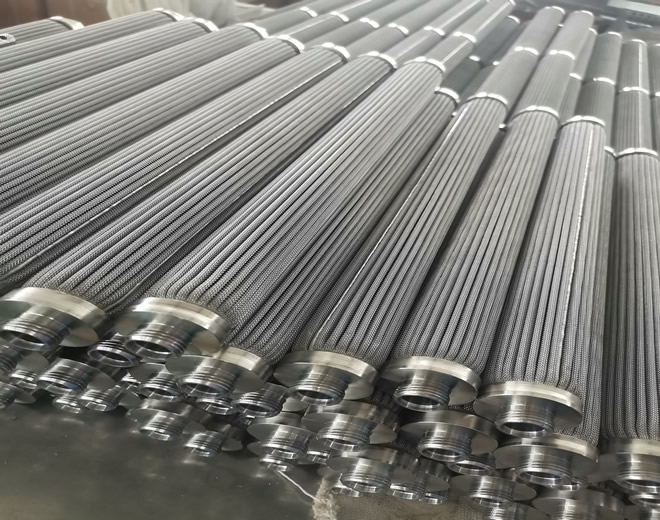
Pleated filter elements typically use woven stainless steel wire mesh as the filtration layer. By pleating the ultra-fine mesh like an accordion bellows, the filtration area per unit volume is significantly increased.
Filtration Mechanism: Primarily relies on surface retention. Particles are trapped on the mesh surface, similar to a sieve.
Structural Features: Multi-layer construction (typically consisting of a protective layer, filtration layer, support layer, and inner/outer cores).
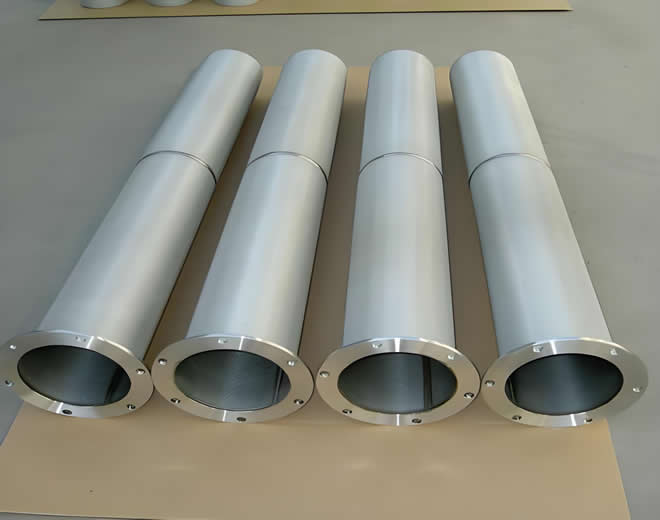
A sintered mesh filter is created by stacking multiple layers of stainless steel wire mesh (usually 5 layers) and sintering them in a vacuum furnace at high temperatures. This process fuses the contact points between layers through diffusion, forming an integrated, rigid, and permeable three-dimensional network structure.
Filtration Mechanism: Combines both surface retention and depth entrapment. Particles are not only intercepted on the surface but are also adsorbed or trapped within the tortuous channels of the multi-layer structure.
Structural Features: Integrated unit, high mechanical strength, no risk of media migration.
Returning to the initial parameters: 2μm vs. 5μm. Looking purely at the lower numerical limit, the sintered mesh does seem superior. However, in industrial filtration, determining "better filtration precision" involves more than just comparing numbers; one must also consider filtration efficiency and stability.
Sintered Mesh Filter Element (2μm): The ability of sintered mesh to achieve 2 microns stems from its three-dimensional tortuous pore structure. This structure facilitates "bridging," allowing it to capture some 2-micron particles via depth interception, even if the pore size is slightly larger than 2 microns. However, it's crucial to note that 2μm sintered mesh typically exhibits higher resistance and falls into the "absolute precision" category.
Pleated Filter Element (5μm): Because woven mesh has a planar sieve-like structure, its 5μm rating refers to the absolute passage diameter. Particles larger than 5μm are 100% intercepted on the surface. Although its nominal lower limit is 5μm, its flow capacity is generally much higher than that of sintered mesh at equivalent precision.
Conclusion: If your goal is absolute filtration (meaning all particles larger than a specific size must be retained), a 5μm pleated filter might be more reliable than a 2μm sintered mesh, as the pore size of pleated mesh is typically more uniform and regular.
Sintered Mesh: Due to the high-temperature sintering process, the mesh pores are permanently fixed. They will not shift or deform under high differential pressure or during backwashing. This means its precision degrades very slowly over long-term use.
Pleated Filter Element: The filtration layer of a pleated element is unsintered woven mesh. Under high-frequency pulse backwashing or high differential pressure conditions, the wires may shift or cause the media to bulge, leading to localized pore enlargement and a subsequent decline in precision.
Since both have their own merits regarding precision, the key to selection lies in the specific application scenario.
Requires High Flow Rate: The pleated design significantly increases filtration area, resulting in low pressure drop. For example, in large pipeline filters in water treatment or petrochemical industries, pleated elements are the mainstream choice.
Used as Pre-filtration or Final Filtration: In the 5μm-200μm range, pleated elements offer good cost-effectiveness and are relatively easy to clean.
High Fluid Viscosity: High-viscosity fluids tend to clog sintered mesh easily, whereas the larger open area of pleated mesh provides better performance.
Precision Filtration at High Temperatures: In applications like polyester spinning or high-temperature gas purification, the rigidity of sintered mesh ensures that its precision remains unchanged even with thermal expansion/contraction.
High-Pressure Backwashing Scenarios: In systems requiring repeated reverse cleaning with high-pressure gas or liquid (e.g., oilfield water injection), the strength of sintered mesh is the only viable option.
Applications Requiring High Dirt-Holding Capacity via Depth Filtration: Although 2μm sintered mesh has a higher initial pressure drop, its three-dimensional structure can hold more contaminants, delaying surface blinding.
Question: Which provides better filtration precision?
Comprehensive Answer:
If by "precision" you mean the minimum particle size that can be filtered (ultimate precision), then Sintered Mesh Filter Element (2μm) wins based on the data.
If by "precision" you mean filtration reliability and pore size uniformity, for particles larger than 5μm, Pleated Filter Elements offer more stable sieving performance.
If you need to consider precision retention under high pressure and high temperature, Sintered Mesh Filter Element is the definitive winner.
Recommendation:
When you need to filter fine particles in the 2-5μm range, Sintered Mesh Filter Elements are the only choice.
When filtering in the 5-50μm range with very high flow requirements, prioritize Stainless Steel Pleated Filter Elements.
When your system experiences significant pressure fluctuations or requires frequent backpulsing, choose Sintered Mesh Filter Elements to prevent element deformation and precision failure.
In the battle of precision, there is no absolute winner—only the option that is most suitable for the specific operating conditions.